Between Trigger and Response: What We Carry, What We Hand Down

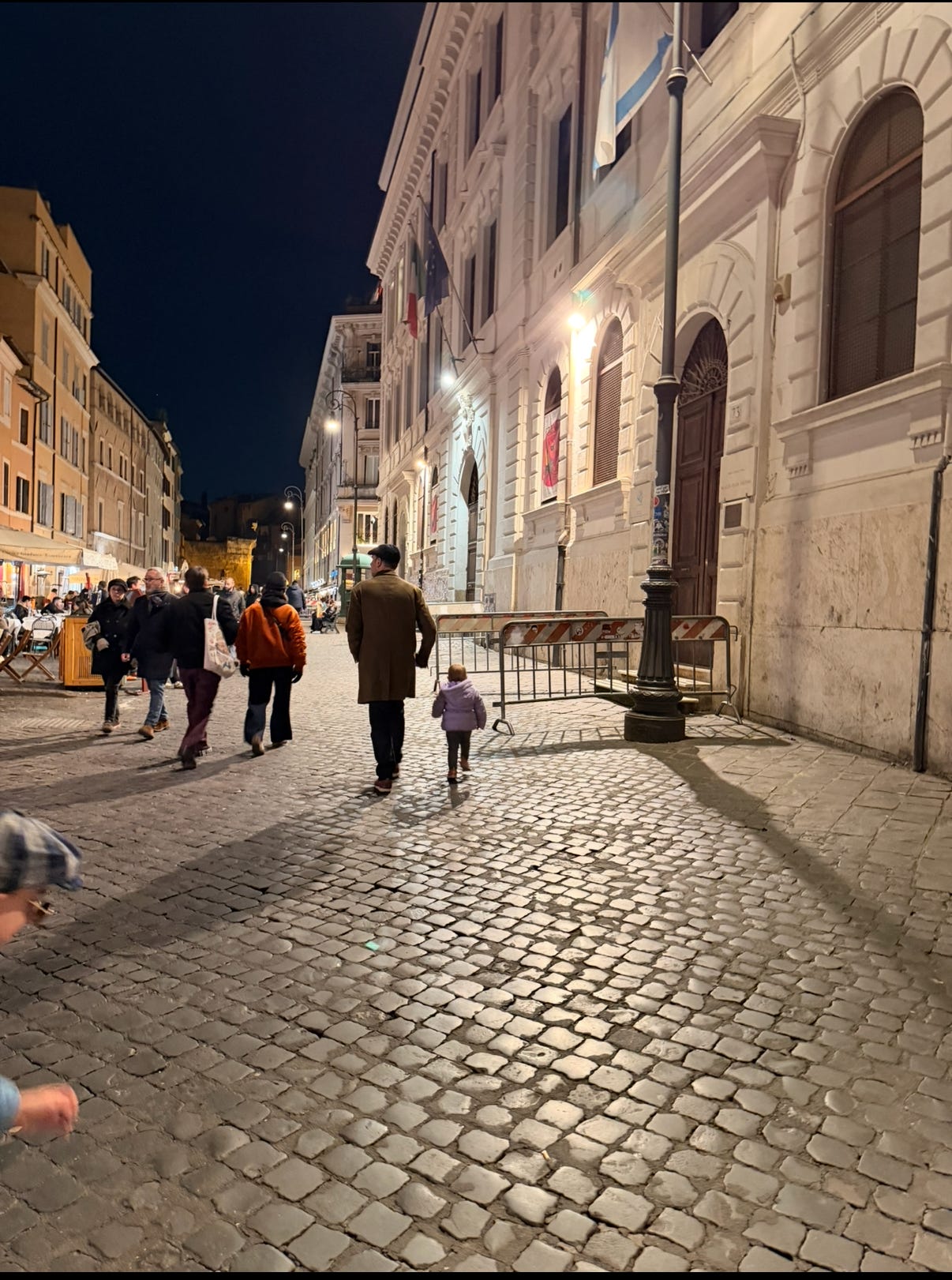
We were standing outside the train station in Rome, waiting for our Uber to arrive, gathered at the designated pickup point in a loose, tired cluster that felt familiar after a long day of moving through the city. My husband was focused on logistics, shifting us slightly up and down the block so the driver could find us.
I was holding the baby, really a toddler now, her weight settled into my body in that familiar end-of-day way that comes after hours of movement. We had just folded up the stroller, which collapses into a bag, and set it at my feet, even though she was adamant that she wanted to walk. On this trip she had discovered that she loves to walk, miles even, claiming the city with a kind of stubborn delight. The older two stayed close. I had a shopping bag slung over one shoulder and a backpack on my back. My husband wore his as well.
It was dark out, though not late, around 5:45 in the evening. The city still hummed. People moved in and out of the station. Cars slowed, idled, pulled away. It was an ordinary moment, the kind that doesn’t usually register as meaningful until something shifts.
I noticed a man.
He was moving erratically, swerving as he walked, his speech slurred as he muttered to himself. There was a bandage wrapped around his lower leg, and he kept going in and out of a small store at the entrance of the station. I noticed the growing presence of carabinieri and police nearby, the way their attention subtly tightened, the way the air changed just enough to feel it.
As he walked up and down the street, he passed close to us. Close enough that he bumped into me.
My body moved before my mind had time to catch up. I pulled my children in tighter, shifted myself between them and him, tracked his movement while still holding the toddler, still listening for the sound of our Uber, still appearing calm to anyone watching.
This is one of the quiet tensions of parenting with a trauma-shaped nervous system: knowing how to protect without transmitting alarm. My body knew what to do. My parenting work was to make sure my children did not have to know why.
A moment later, as our car was arriving, he moved toward another family and tried to grab the woman’s bag. She yelled. The police ran. The situation resolved itself quickly to our periphery.
Once we were inside the Uber and the doors closed, I asked my husband and the kids if they had noticed what had just happened.
Not one of them had.
Even as the street disappeared behind us, I felt my body stay braced for a few seconds longer, as though it hadn’t yet received the message that the moment had ended. I held the baby close to me and felt my heart rate come down against her back, breathing in her soft hair.
That space - the in between - is familiar to me.
Later on in the trip, on a busy shopping street packed with people and noise, I heard what sounded like gunshots. Three loud pops, sharp and close together. My body reacted instantly. I reached for my children, pulled them slightly toward the side, scanned for exits, for something solid.
Then I noticed what didn’t match.
There was no screaming, no running, no rush of energy. The crowd stayed steady, and so we walked on. A moment later, I saw a group of kids further down the block laughing as they set off small firecrackers.
Nothing dangerous. Just noise.
I was aware of how I had to consciously remind myself where I was, what I was hearing, and that this moment was not asking the same thing of me as others I’ve lived through, and others I read about almost daily. I also reminded myself that my children were watching my face, my body, my breath, learning from me what moments like this mean. When my daughter looked up at me with questioning eyes, I said, “I find it so odd that kids play with things that sound like guns.” She nodded, perhaps understanding what I hadn’t said, perhaps already having moved on to admire the colorful jewelry on the stand next to her.
As we moved through different cities in Italy, I noticed other things too. Palestinian flags hanging from windows. Anti-Israel graffiti, subtle but present if you were looking for it. In Naples, an advertisement for a pro-Palestinian rally that had already taken place, still posted as part of the everyday landscape. On a billboard for a children’s toy store, someone had scrawled the words “destroy Israel.” I found myself wondering whether my kids were noticing, or whether this was one of those layers that only adults carry.
Parenting often means carrying what we choose not to hand down. Many times throughout our trip, I held back the urge to point these things out, to name every layer I was noticing. Instead, I walked on, relegating those details to the background. Not because they didn’t matter, but because not everything we carry needs to be shared in real time.
Walking through the world as a Jewish person means noticing these things. Walking through the world as an Israeli person does too, even when that identity isn’t immediately visible. I was aware of when my son slipped Hebrew words into his sentences, the way he likes to do, and the way I would subtly look around to see if anyone was listening. I noticed the security around Jewish spaces, ancient and contemporary alike, so familiar they can fade into the background unless you are trained to see them. I held the sadness and relief that come with knowing that my babies can run around the synagogue’s fenced-in yard because heavily armed soldiers are guarding them.
Trauma does not disappear with time. It reorganizes the body and integrates into a person’s lived experience. It teaches the nervous system to move early, to snap to attention at something others might not notice, sometimes years or decades after the original danger has passed. For some people this learning begins in childhood. For others it accumulates through repeated exposure. Either way, the body remembers, reacts, reorganizes.
Parenting with that kind of body means constantly translating. Deciding what to act on internally and what to narrate externally. Choosing when to protect quietly and when to help a child make meaning. Figuring out what belongs to us and what does not need to become our children’s inheritance is a constant balancing act.
That awareness can be protective. It sometimes helps me keep my children safe, teaching them to be vigilant and aware without teaching them to be afraid. It allows me to notice subtle shifts in people and spaces before they surface fully, to sense when situations have already passed their sell-by date.
It can also mislead. Sometimes my nervous system tells me stories that aren’t quite there yet. I feel my heart race, heat rush to my extremities, my body ready to run or fight. When that happens, the work isn’t to ignore the signal, but to check it against the present moment and help my body recalibrate and regulate, so my children learn discernment, not alarm. Also, so I can function: work, teach, counsel, parent, be.
As a rabbi, and as someone who does pastoral work with kids and teens, I spend a lot of time paying attention to what happens before anyone names it.
Most people don’t come in saying exactly what they’re struggling with, especially not kids and teens. They show you instead. In how they walk into the room, in whether they make eye contact, in the way they are holding their bodies. It can be in how much space they take up, or how carefully they try to disappear into the background. Sometimes it’s a change in energy. Sometimes it’s something more physical, a different gait, shoulders slumped where they’re usually loose, a kid who suddenly looks smaller than they did the week before.
Part of the work is deciding what to do with what I notice.
Sometimes it’s right to name it gently. You seem a little quieter today. You’re moving differently—what’s going on? Other times, the most attuned response is much simpler. A warm hey, it’s so nice to see you here, said without expectation, without follow-up, just enough to let someone know they’ve been noticed and they’re welcome as they are.
When conflict comes up, the lesson isn’t only in what I say. It lives in how we hold the moment together. Whether we rush, whether we escalate, or whether I can stay steady enough to let discomfort sit for a moment without trying to smooth it over. Teens notice this right away. They are always watching to see whether adults can stay present with tension, whether we can be there for them without overtaking the space.
Many of us carry this way of moving through the world, even if we’ve never named it. It runs quietly through our tradition. Torah returns again and again to moments where wisdom comes not from speed or certainty, but from restraint: watching before acting, waiting long enough for understanding to form, allowing time and behavior to show us what a moment can actually hold. Our ancestors are rarely praised for rushing. They are shaped in pauses, in wrestling, in silence, in choices made slowly after harm has already occurred.
For parents, this inheritance matters. It reminds us that noticing early does not require immediate action, and that waiting is not the same as ignoring. The pause between trigger and response is not a failure of protection; it is where protection learns discernment. When we trust that narrow middle space, vigilance softens into wisdom, and our children learn not fear, but how to come back to steadiness when the moment allows.
In practice, this often looks small. A child trips and falls. Instead of rushing in with you’re okay or firing off questions, we pause. We name what we see. You fell. That was surprising. We help them breathe. We wait for their body to catch up before deciding what comes next. We might ask, are you scared or hurt?
In our family, we sometimes say the word “wipeout!”—a gentle way of reminding ourselves that something sudden happened, that it might have felt scary for a moment, and that falling is part of learning how to move through the world. Regulation happens because we stay close and steady while it unfolds.
I keep thinking about a post I wrote last year, when we visited Israel during a period when sirens were part of daily life, but not the usual for us. At the time, my nervous system felt constantly alert, braced for sound. Recently, my daughter and I were walking near home when the alarm from the fire station up the road went off. It sounds almost exactly like a siren. I felt my body register it immediately, that familiar prickle, the split second of orientation. She noticed it too, but differently. She commented on the sound almost casually, the way you might note a passing truck. The contrast between the way my reaction still exists and the way hers has softened was striking. She can notice without alarm. I can feel what my body remembers, and also feel myself deliberately come back.
Standing outside that train station in Rome, surrounded by my family, I was reminded that many of us live just ahead of the moment - and can experience a moment through different layers than someone standing right next to us. Parenting, and leadership, ask us to do something brave with that: to carry what we’ve learned without passing it on unexamined, and to teach those in our care not fear, but how to come back to safety when the moment allows.
That is how vigilance becomes wisdom rather than weight.
A few things I’m holding:
Noticing danger early does not mean danger is present, or that it ever will be.
Awareness and alarm are not the same. We can notice things that amount to nothing and choose not to pass them on.
Children learn regulation by watching how adults recover, not only how we react. A reaction might be a raised voice; recovery can look like naming it, apologizing, and resetting.
Naming what we see (you fell, that was surprising) is often more regulating than reassurance (you’re okay!), which can feel mismatched to a child’s experience.
Discernment matters more than speed in parenting, leadership, and care. We don’t have to respond immediately; we can take a breath, a beat, a moment.
Absence carries information, just as presence does. Silence, withdrawal, or distance can speak as loudly as words or behavior.
The pause between trigger and response is not inaction; it is where wisdom forms. Waiting - without waiting too long - can create space for growth.
Vigilance becomes a burden when it goes untended, and wisdom when it is guided. The work of care, reflection, and healing matters as much as the message itself.